
Safeguarding training is mandatory for all members of the dental team, and this webinar explores how dental professionals play an essential role in the safeguarding of patients and colleagues.
In this College-hosted webinar, speakers Preetee Hylton, Dr Alison Gregory and Dr Sandi Dheensa examine different types of abuse, explain how to recognise signs that someone is being subjected to abuse and how to act accordingly to preserve your patients’ and colleagues’ safety. The webinar also explores the importance of creating a safe space for employees to ask for help and will introduce the Employer’s Initiative for Domestic Abuse (EIDA), an evolving community working towards supporting domestic abuse victims, and providing access to services to help perpetrators to stop.
Introduction:
Abhi Pal, President of the College of General Dentistry
Speakers:
Preetee Hylton, Restorative Dental Nurse, Safeguarding Lead and survivor of domestic abuse
Dr Alison Gregory, Senior Research Fellow, Domestic Violence and Abuse Health Research Group, Bristol Medical School
Dr Sandi Dheensa, Research Fellow, Domestic Violence and Abuse Health Research Group, Bristol Medical School
It was free to view live for all dental professionals, and College members also have free access to the recorded webinar and can claim CPD hours for free. A £20 fee will apply for non-members who wish to claim CPD.
Membership of the College of General Dentistry is open to all registered dental professionals. Membership for dentists is available from £94, and for other registered dental professionals from £33. The full list of CGDent membership rates is at https://cgdent.uk/membership-fees/.
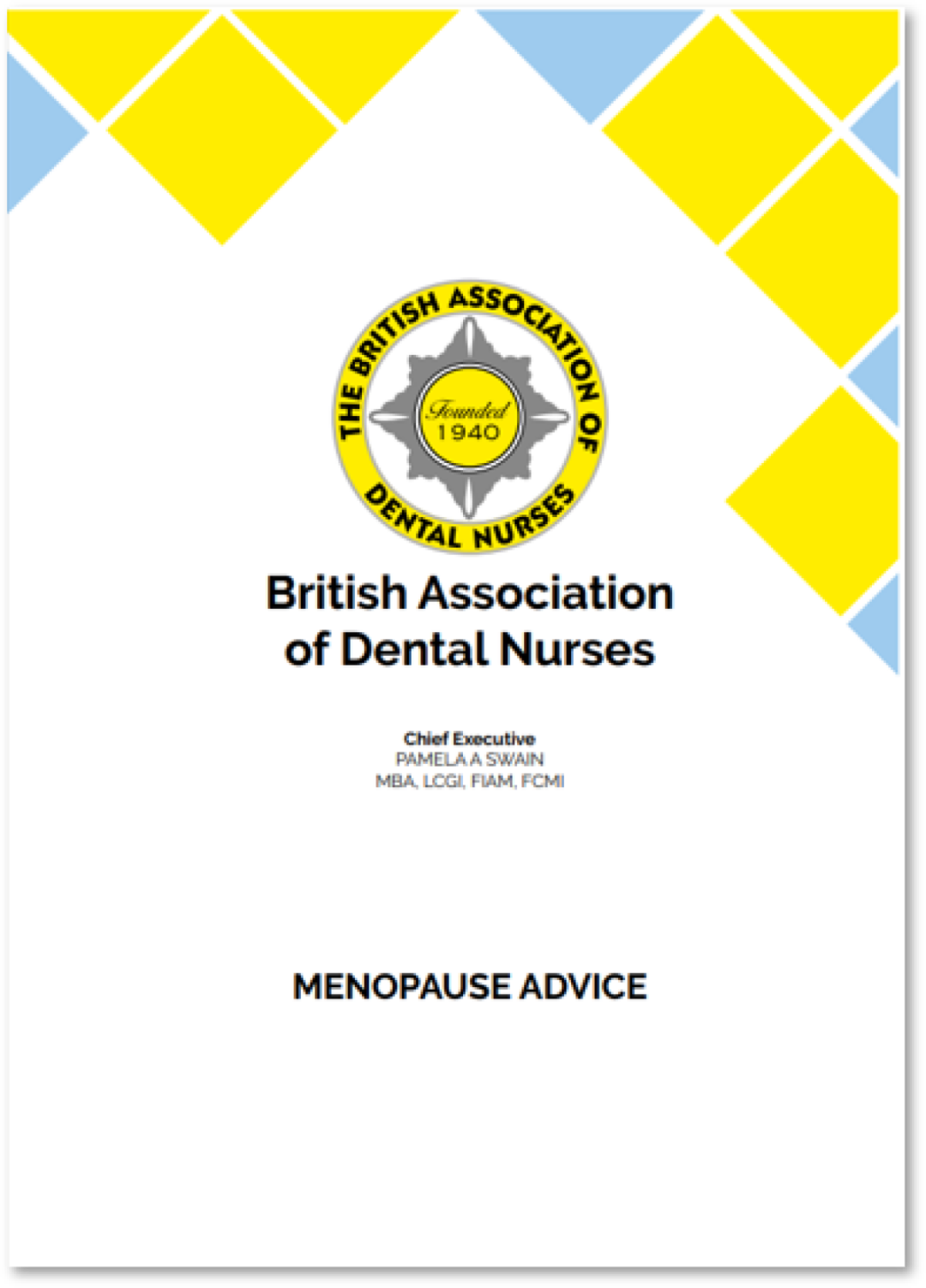
The College has endorsed the menopause policy and advice recently published by the British Association of Dental Nurses (BADN).
In the UK, 99% of dental nurses, 96% of orthodontic therapists, 94% of dental hygienists, 92% of dental therapists, 52% of dentists and 27% of dental technicians are female – 78% of the regulated dental profession as a whole – and the policy outlines the challenges faced by menopausal women in the workplace and suggests ways in which employers can support menopausal employees.
The Association is asking dental practices, laboratories and clinics to adopt the policy and implement it in their workplace, and is asking dental organisations to support it by encouraging its widespread adoption.
The College of General Dentistry, membership of which is open to all dental and oral health professionals, is the first organisation representing dentists to do so. The College is the independent professional body into which the Faculty of General Dental Practice transferred last year, and is the UK’s only medical college run by and for oral health professionals.
Abhi Pal, President of the College of General Dentistry, said:
“The BADN’s Menopause Policy is important, practical and succinct advice which helps dental professionals to better understand the menopause, to appreciate relevant employment law, and to implement a menopause policy in their practice.
Making appropriate adjustments for staff affected by the menopause is both a moral duty enabling committed and experienced colleagues to remain in valuable employment, and a legal duty not to discriminate on the grounds of gender, age or disability. Supportive dental practices and understanding employers will also find they benefit in return from improved staff retention and reduced sickness absence.
On behalf of the College, I congratulate the BADN on its publication, and am pleased to endorse it.”
The policy is also supported by the British Society of Hygiene and Therapy (BSDHT), the British Association of Dental Therapists (BADT), the British Dental Industry Association (BDIA), the Dental Laboratories Association (DLA), the Dental Technologists’ Association (DTA), the Orthodontic National Group (ONG), and the British Veterinary Nurses’ Association (BVNA).
The publication is available on the BADN website here.
This webinar was previously scheduled for 15 September 2022
In this webinar, we aim to demystify issues around handling patient data: how to store data, how to use it and how to share it within current guidelines and best practice. We provide an overview of Caldicott Principles, information sharing for patient care and GDPR. We also look at the role of digital technology in information sharing, and how to share information safely and securely in your practice.
CGDent members and ProDental subscribers have free access to the recorded webinar and can claim CPD hours for free. A £20 fee will apply for non-members/non-subscribers who wish to claim CPD.
This webinar is powered by our CPD delivery partner, ProDental CPD.
Membership of the College of General Dentistry is open to all registered dental professionals. Membership for dentists is available from £94, and for other registered dental professionals from £33. The full list of CGDent membership rates is at https://cgdent.uk/membership-fees/.
The College has announced that it will be launching its much-anticipated Professional Framework next month.
Guests celebrating the launch of the College at Barber-Surgeons’ Hall, where the Professional Framework will be launched next month at the Fellows’ Summer Reception
The Professional Framework will describe the knowledge, skills and other attributes that primary care dentists and other dental professionals may aspire to at different stages of their career, and underpins the College’s Career Pathways programme. An initial framework published last year identifies five domains:
Clinical and technical: the capability to diagnose, to advise and to treat
Professionalism: the conduct and behaviour to engage patient trust and confidence
Reflection: awareness of personal impact, abilities and limitations
Development: commitment and capability to improve the service to patients
Agency: the ability to resolve solutions independently and through others
The creation of career pathways for general dental practice was a key founding purpose of the College, which has been developing sets of progressive steps for each dental team role in order to provide purpose and direction for dental careers, to enhance professional standing, and to help retain and nurture a motivated workforce.
The Professional Framework will be launched at the inaugural Fellows’ Summer Reception, which takes place on Wednesday 15 June at Barber-Surgeons’ Hall in London. It will be preceded by the conferral of Fellowships, President’s Commendations and the prestigious College Medal, and will take place in front of around a hundred guests.
Fellows and Associate Fellows of the College, as well as FGDP Fellows who were unable to enjoy formal conferral of their fellowship during 2020-21 due to coronavirus restrictions, are eligible to attend. Tickets are £20, to include wine and canapés, and a small number of spaces remain.
Dental Hygienist, Frances Robinson AssocFCGDent, has recently completed the Clinical Oral Health Transformation Fellowship with HEE. As the first ever dental care professional in any clinical fellowship role, Frances explains what was involved.
A fellowship is a position, often combined with clinical work, that focuses on the learning and development of the individual taking part. Fellowship roles in the healthcare profession aim to expand opportunities for aspiring leaders; helping them gain the necessary experience and skills for future system leadership roles. As such, there are a range of opportunities to be involved with projects and programmes and to work in settings outside a clinician’s normal exposure. There can be specific goals of writing, submitting, and publishing papers, attending meetings and conferences, and working on particular projects, as well as networking. The balance of these is dependent on the host organisation.
I have just completed a one-year position with Health Education England (HEE) as their Clinical Oral Health Transformation Fellow. HEE’s purpose is to support the delivery of excellent healthcare to patients, by ensuring that the workforce has the right numbers, skills, values and behaviours. Thus, the areas I worked on related to the development of the oral health work force.
I was the first dental care professional (DCP) to be awarded the clinical fellowship, these roles are typically fulfilled by a dentist. I am extremely grateful for this innovative appointment both for my personal development and the development of my career, but also for other DCP colleagues, for now it has opened up new realms of opportunities for us to progress in system roles.
I applied for the role because of the potential to gain experience working in the public health sector, whilst allowing me to work clinically at the same time. Having completed a Masters in Dental Public Health in 2017 – spurred on by my interests in health inequalities research – I felt this position would be an excellent opportunity for me to develop my career.
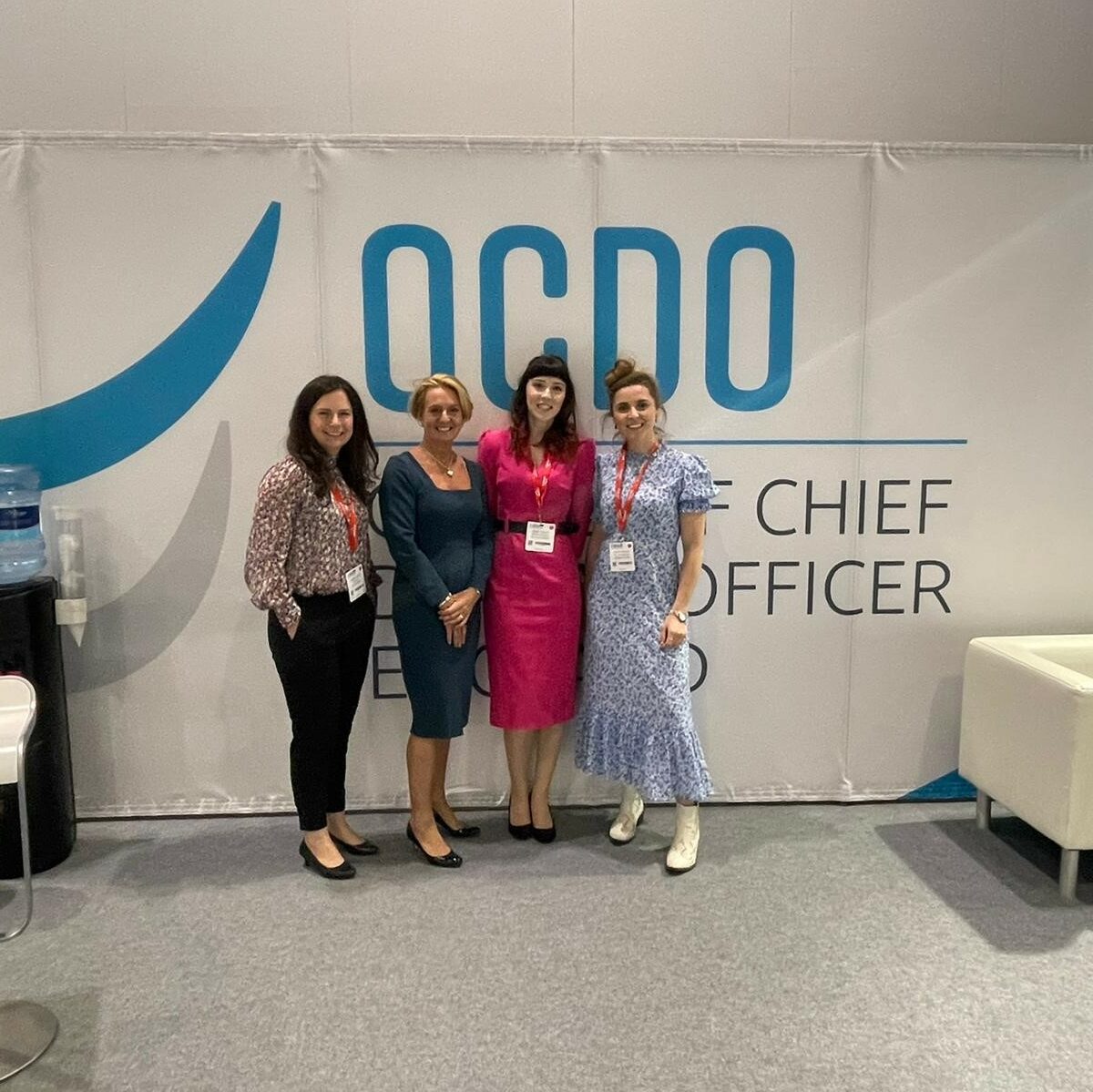
At the CDO stand with Sara Hurley and other fellows at the BDIA showcase
During a fellowship there is flexibility to align the projects undertaken to individual interests, whilst working for the greater aims of an organisation. This means there is a real opportunity to tailor a role to where there is the most personal or organisational benefit. My aims for the year working with HEE were to work on projects that I’m interested in, for example oral health inequalities, oral health empowerment and promotion, increase my skill mix and exposure to multidisciplinary team working in primary care, as well and develop opportunities for leadership and management for all members of the dental team.
I am currently writing up multiple papers to be published; one evaluates the success of a pilot that aimed to reduce the number of paediatric patients sent to secondary care for dental extractions under general anaesthetic. A subsequent paper will evaluate the success of the “return to work” therapy scheme, a programme aimed at supporting Dental Therapists who have not been using their full scope of practice, back into therapy work by providing them with training opportunities, supervisor support and a practice placement. I will also be helping to write a concept paper for a Dental Hygiene postgraduate training programme.
During my time with HEE, I have had the chance to sit on various working groups like a “Managed Clinical Network” and interact with external organisations such as Public Health England, academic institutions, professional societies and local councils.
A clinical fellow may also have the opportunity to attend courses and gain qualifications that are not linked to their clinical work; I was selected to complete an Institute of Leadership and Management, level 7 qualification through HEE. I received three days of training with UMD Professional and then completed a research element which involved interviewing my colleagues at the HEE dental office.
Furthermore, I am currently completing a “Becoming an Expert Educator in the Healthcare Professions” course with the University of Nottingham. These additional skills and qualifications are important for demonstrating tangible outcomes from the year.
It has sometimes been a trying year due to the pandemic – working from home during a fellowship has meant less interaction with colleagues and difficulty integrating into an office very different from a clinical setting. Natural communication with colleagues is often stilted when working virtually. I subsequently created ice breakers for meetings with my peers to stimulate organic conversation!
There are other fellows across the country with HEE and in other organisations for example with the Chief Dental Officer, General Dental Council, Care Quality Commission and NHS England and NHS Improvement (NHSE&I). We have a clinical fellow networking group where collaborations across work streams can be facilitated and a journal club takes place. This has given me the chance to network with new professionals across medicine and dentistry which has been really enjoyable! The fellows try to see each other in person despite being spread out across the country– the most recent of which was at the BDIA Dental Showcase at ExCel London.
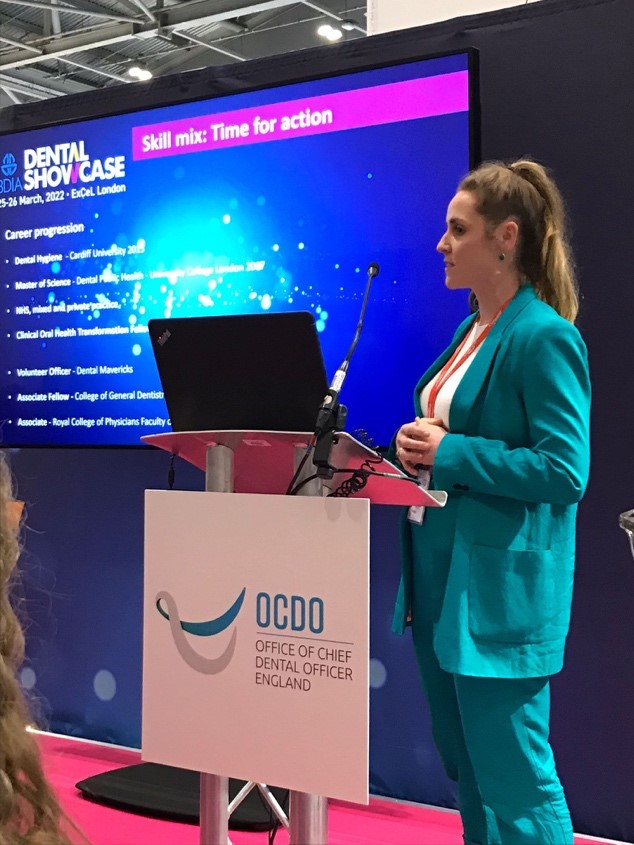
As I was the first fellow at Health Education England to be a DCP I was – and still am – in a unique position to be an advocate for DCPs, working hard to make our voices heard across a variety of settings. I was asked to do a presentation at the BDIA conference on workforce and skill mix. I focused on the skill mix in our systems, policy, planning, commissioning, leadership and management. I am passionate about DCP representation in all of these areas as I truly believe that if we are represented throughout the system we will have a more empowered workforce. If you’re interested in taking up a Fellowship position, keep an eye on NHS jobs, HEE jobs, FMLM for dentists and your professional society pages.
Presenting at the BDIA showcase
The College of General Dentistry has a unique structure with exciting opportunities to create connections between different dental professionals against an academic backdrop. There are no other organisations in the industry now that represents all dental registrants in this way. The careers pathway programme will be able to support individuals navigating their fields; there will be guidance, support networks and mentors available to enhance learning and progression. I personally am very excited to have a structure in which to work, with industry recognition of the level attained. I know that many DCPs have much to offer the wider industry with postgraduate qualifications and extensive experience in many areas, as well as evidence of enhanced learning. The College will enable these efforts to be verified through a framework where all dental professional are assessed equally. This certainly is an exciting time for us all.
Frances Robinson chairs the Dental Hygiene & Dental Therapy Group on the College’s Career Pathways programme.
In-person expert panel discussion and Q&A, Tuesday 4 October, 6.30pm
King’s College London, New Hunt’s House, Guy’s Hospital Campus, London
Professor Avijit Banerjee and an expert panel of guests, explored the renewed emphasis on Minimum Intervention oral healthcare prevention delivery and the College of General Dentistry’s related career pathways for primary care team members.
Discussion programme
Primary care, team-delivered prevention-based MI oral healthcare delivery in the context of impending NHS dental contract reform and post-pandemic primary care service delivery.
NHS policy development for prevention-based phased care and its wider implications in society.
Structured postgraduate career pathways for all oral healthcare team members, delivered through the College of General Dentistry frameworks, and highlighting the King’s master’s programme in Advanced Minimum Intervention Restorative Dentistry (AMIRD) designed for dentists and dental therapists working in primary care, globally.
The College of General Dentistry has broadened its eligibility criteria for membership, enabling suitably qualified non-registrants to join, and offering practitioners with relevant non-dental qualifications the ability to progress to higher grades of membership.
Registration with the General Dental Council or an equivalent overseas authority is normally required for entry as an Associate Member. However former registrants, and those who hold a relevant qualification but may not be required to register with the GDC due to their job role – such as dental academics – are now eligible to join.
Those wishing to join as Full Members (MCGDent), or upgrade to Full Membership, have until now been required, in addition to meeting the requirements for Associate Membership, to hold either the DGDP, MJDF, MFGDP(UK), MFDS or a Postgraduate Certificate level qualification in a ‘relevant dental subject’. However Full Membership is now also open to those whose qualification is in a ‘subject relevant to the enhancement of oral healthcare’.
Those wishing to join at, or upgrade to, Associate Fellowship (AssocFCGDent), have up to this point needed to hold the MGDS, a Specialty Membership of a UK dental faculty, or a Postgraduate Diploma level or Masters level qualification in a dental subject. However, this recently-instituted membership grade, which offers a stepping stone to Fellowship, is similarly now available to those whose qualification is relevant to oral heath rather than being strictly ‘dental’ in scope.
Individuals qualifying under these extended criteria would then be eligible to apply for Fellowship (FCGDent) on the same basis as all other members of the College. This is currently open to existing Fellows of a UK Royal College or overseas equivalent, with a Fellowship by Experience route expected to be announced soon.
The changes are further to earlier departures from the eligibility criteria of the former Faculty of General Dental Practice, from which the College evolved – most notably the ability of Dental Hygienists, Dental Therapists, Dental Nurses, Dental Technicians and Clinical Dental Technicians to apply for membership at all grades, and for Practice Managers and other non-clinical members of the dental team to join as Affiliate Members.
“Among the key aims behind the establishment of The College of General Dentistry were the promotion of both dental and oral health, and to create a new type of college, breaking down barriers which are unnecessarily prescriptive and exclusionary, and replacing them with an inclusive approach fit for the 21st century.
“We are implementing this step by step, and are already a College open to all members of the dental team, formed of practitioners across the UK and beyond, and bridging the NHS/private divide.
“These latest changes offer recognition to a wide range of individuals and professional roles whose contribution to the advancement of general dental practice and oral healthcare is hugely significant, and we look forward to welcoming them into membership, and to bringing their significant knowledge, expertise and experience to bear in the fulfilment of our mission.”
Elections will soon be held for seven seats on the Council of the College of General Dentistry, and eligible members are encouraged to consider standing.
The Council is elected by College members to provide leadership and support for the dental professions, and to guide the College Trustees in fulfilling the College’s mission.
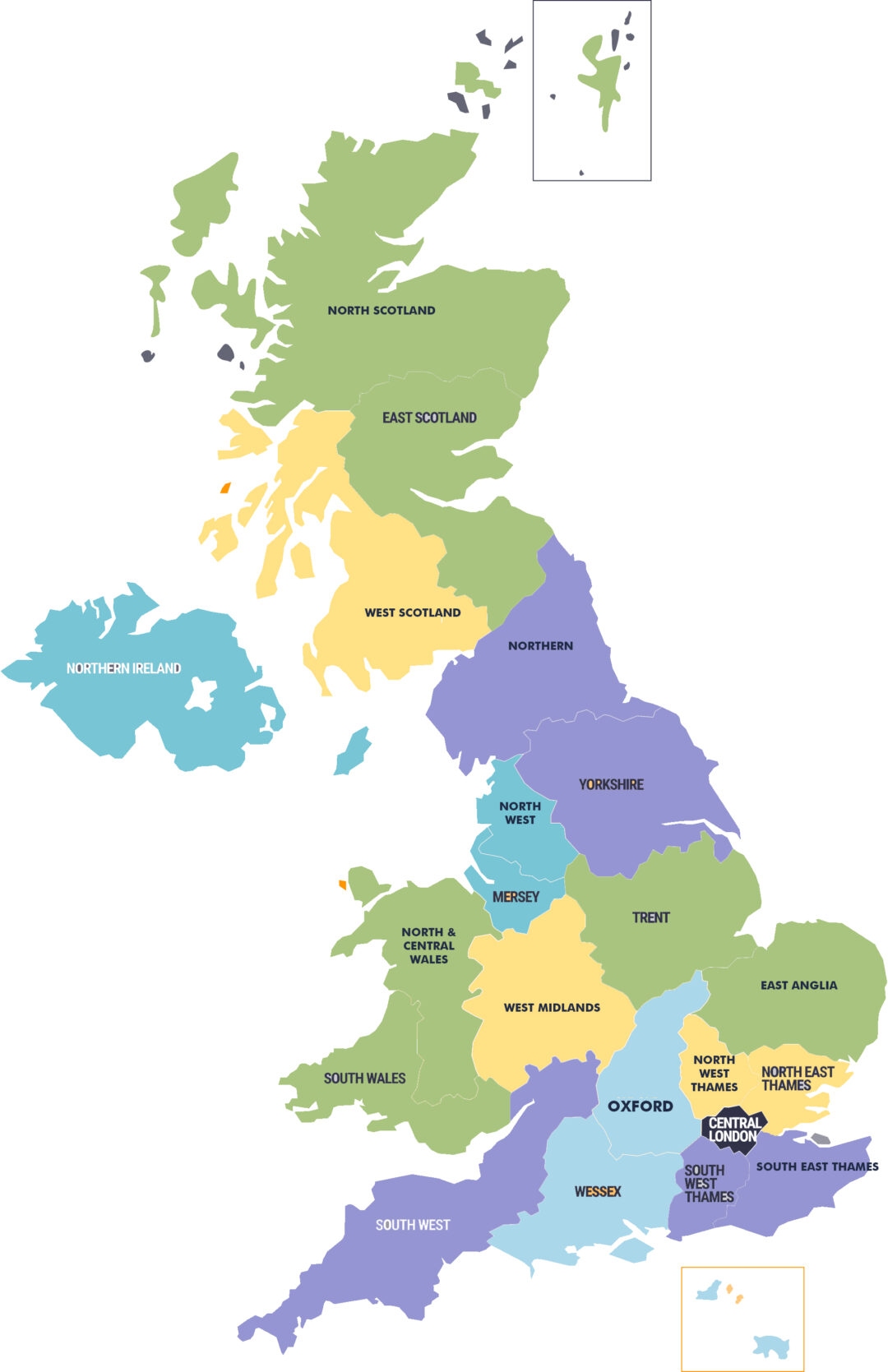
It includes representation based both on geographical region and professional role.
Members of the Council serve three-year terms, and elections will shortly take place for the following seats:
Yorkshire and Northern
Central London
Wessex & Oxford
East of Scotland
West & North of Scotland
Overseas representative
National representative
Those elected would be expected to serve from June 2022 – June 2025, and would then be able to stand for re-election. Further seats will be due for election in 2023 and 2024.
Council members are expected to attend three face-to-face meetings each year, which normally take place on a Friday morning in June, October and February, as well as regular online meetings outside of business hours. Those elected this year will be formally inducted at the Council meeting on Friday 24 June in Cardiff.
Members of the Council may serve up to three elected terms (i.e. nine years), and are eligible to stand in the annual election of two Vice Presidents, and the triennial election of a College President.
All Full Members, Associate Fellows and Fellows of the College, regardless of their dental team role, are eligible to nominate themselves as candidates for election to Council.
Candidates for regional seats must live or work within that region, and be registered with that region with CGDent.
Candidates for the National seat must live or work in the UK, and have a registered UK address with CGDent.
Candidates for the Overseas seat must practice dentistry wholly outside the UK, and have a registered overseas address with CGDent.
Associate Members wishing to nominate themselves for election will need to have successfully completed an upgrade to Full Membership before submitting an application.
An online application process, accompanied by a full description of the role, will be published no later than Friday 18 March 2022, and the deadline for submission of applications will be no earlier than Friday 15 April.
A full election timetable will be published in due course; please return to this page over the coming weeks for updates.
The CGDent UK regions map (above) can be downloaded here. Prospective candidates unsure of their CGDent region should contact us here.
The College of General Dentistry and British Association of Dental Nurses (BADN) are warning of a potential catastrophe for dental patients if the planned implementation of mandatory COVID-19 vaccinations for all patient-facing staff in England is not deferred.
Regulations came into effect earlier this month that will make it unlawful from 1 April 2022 for a CQC-regulated employer to deploy staff who are not fully vaccinated to work face-to-face with patients. The rules, which will apply to NHS and private providers alike, will effectively force dental practices to dismiss staff who have not received their first dose of an approved coronavirus vaccine by 3 February, and second dose by 31 March, unless they are clinically exempt, under 18, taking part in a COVID vaccine trial or can be redeployed into a non-patient-facing role.
Both the College and BADN are unequivocal in their encouragement of dental professionals to take up the offer of coronavirus vaccination. However, interim results from the BADN COVID Vaccination Survey, based on the responses of over 1,000 practising dental nurses to date, show that 26% have not yet received two vaccination doses, and 24% will not have been double-vaccinated by the deadline.
Responses to date are similar for both members and non-members of the association. If the findings are representative of the dental nursing profession as a whole – which makes up half the dental workforce – this would suggest an impending reduction in available dental staff in England of up to 12,000, or 12%, plus any dentists, dental therapists, dental hygienists, clinical dental technicians or orthodontic therapists who may not be double-vaccinated.
The survey also found that 32% of respondents so far said they do not intend to take up the offer of a ‘booster’ dose, suggesting that staffing problems will only increase if the definition of ‘fully vaccinated’ is later amended to require three doses.
Dr Abhi Pal, President of the College of General Dentistry, and Jacqui Elsden, President of the British Association of Dental Nurses and an Associate Member of the College, said:
“Dental nurses are a vital part of the team without whom dental care cannot be delivered, and the BADN’s data will only strengthen existing concerns in practices across the country.
“Tens of millions of dental appointments have been missed during the pandemic, but while welcome additional funding has just been announced by NHS England to help tackle the backlog during February and March, losing up to a quarter of dental nurses from 1 April would lead to a precipitous reduction in care provision, quickly reversing any progress made and leaving millions of dental patients once again unable to get the treatment they need. We urge the government to defer implementation of the vaccination requirement for dental employers in order to avert a calamitous own goal.”
Tonight at 7pm, a week ahead of the deadline to take up the first vaccination dose, the College is hosting Vaccination: your questions answered.
Free for all dental professionals to watch live, speakers include Professor Jason Leitch, (Senior Clinical Advisor to the Scottish Government, CGDent Ambassador and regular explainer of all matters COVID in the broadcast media), and Sarah Buxton (HR and Employment Solicitor and legal advisor to the Association of Dental Administrators and Managers and the British Society of Dental Hygiene and Therapy). Register here
CGDent members and ProDental subscribers have free access to the recorded webinar and can claim CPD hours for free. A £20 fee will apply for non-members/non-subscribers who wish to claim CPD.
In conjunction with the Central Sterilising Club, this webinar examines how we can promote sustainability in dentistry and healthcare, addressing issues such as disposable single use items and the efficacy of decontamination and reuse on site. The current disposal of items across healthcare is not sustainable and we need to change our practices to ensure that reuse and reduce are the principles to reduce waste. Yet, there are other considerations including infection control, the ongoing risk to patients as well procurement and transport to and from our places of work.
This webinar sets out to investigate the effect of healthcare on climate change and how nurses can adopt more sustainable nursing practices. We examine how improving sustainability through reusable PPE can reduce the pressure and costs on the NHS and improve the planet, and consider how embedding sustainability within a dental practice can support and advocate change in dentistry.
Speakers:
John Prendergast, Senior Decontamination Engineer at NHS Wales Shared Services Partnership/Specialist Estates Services
Ian Mills FCGDent, former Dean FGDP(UK) and a Trustee of CGDent
Abhi Pal FCGDent, President of CGDent
Rose Gallagher MBE, Professional Lead Infection Prevention and Control at Royal College of Nursing
Alexis Percival, Environmental and Sustainability Manager, Yorkshire Ambulance Service NHS Trust
Brett Duane, Associate Professor in Dental Public Health, Trinity College, Dublin
Dr Jimmy Walker, Independent Microbiological and Decontamination Consultant
Membership of the College of General Dentistry is open to all registered dental professionals. Membership for dentists is available from £94, and for other registered dental professionals from £33. The full list of CGDent membership rates is at https://cgdent.uk/membership-fees/.
We use cookies on our website to give you the most relevant experience by remembering your preferences and repeat visits. By clicking “Accept”, you consent to the use of ALL the cookies.
This website uses cookies to improve your experience while you navigate through the website. Out of these, the cookies that are categorized as necessary are stored on your browser as they are essential for the working of basic functionalities of the website. We also use third-party cookies that help us analyze and understand how you use this website. These cookies will be stored in your browser only with your consent. You also have the option to opt-out of these cookies. But opting out of some of these cookies may affect your browsing experience.
Necessary cookies are absolutely essential for the website to function properly. These cookies ensure basic functionalities and security features of the website, anonymously.
Cookie
Duration
Description
cookielawinfo-checbox-analytics
11 months
This cookie is set by GDPR Cookie Consent plugin. The cookie is used to store the user consent for the cookies in the category "Analytics".
cookielawinfo-checbox-functional
11 months
The cookie is set by GDPR cookie consent to record the user consent for the cookies in the category "Functional".
cookielawinfo-checbox-others
11 months
This cookie is set by GDPR Cookie Consent plugin. The cookie is used to store the user consent for the cookies in the category "Other.
cookielawinfo-checkbox-advertisement
1 year
The cookie is set by GDPR cookie consent to record the user consent for the cookies in the category "Advertisement".
cookielawinfo-checkbox-necessary
11 months
This cookie is set by GDPR Cookie Consent plugin. The cookies is used to store the user consent for the cookies in the category "Necessary".
cookielawinfo-checkbox-performance
11 months
This cookie is set by GDPR Cookie Consent plugin. The cookie is used to store the user consent for the cookies in the category "Performance".
PHPSESSID
session
This cookie is native to PHP applications. The cookie is used to store and identify a users' unique session ID for the purpose of managing user session on the website. The cookie is a session cookies and is deleted when all the browser windows are closed.
viewed_cookie_policy
11 months
The cookie is set by the GDPR Cookie Consent plugin and is used to store whether or not user has consented to the use of cookies. It does not store any personal data.
wordpress_test_cookie
session
This cookie is used to check if the cookies are enabled on the users' browser.
Functional cookies help to perform certain functionalities like sharing the content of the website on social media platforms, collect feedbacks, and other third-party features.
Performance cookies are used to understand and analyze the key performance indexes of the website which helps in delivering a better user experience for the visitors.
Analytical cookies are used to understand how visitors interact with the website. These cookies help provide information on metrics the number of visitors, bounce rate, traffic source, etc.
Advertisement cookies are used to provide visitors with relevant ads and marketing campaigns. These cookies track visitors across websites and collect information to provide customized ads.